子序列问题
最长公共子序列(LCS)
公共子序列即两个字符串中共有的子序列,现在需要寻找两个字符串的最长公共子序列
思路
本质上是选与不选的问题,我们考虑最后一对字母,两两组合有四种情况
更一般化:
- 当前操作:考虑
s[i]与t[j]选或不选
- 子问题:s的前i个字母和t的前j个字母的LCS长度
- 下一个子问题
- s的前i-1个字母和t的前j-1个字母的LCS长度(都选或都不选)
- s的前i-1个字母和t的前j个字母的LCS长度(选s[i]不选t[j])
- s的前i个字母和t的前j-1个字母的LCS长度(选t[j]不选s[i])
转移方程
dfs(i,j) = max(dfs(i-1, j-i), dfs(i-1, j), dfs(i,j-1)+(s[i]==t[j]))
但可以考虑两个问题:
s[i]==t[j]时,需要dfs(i-1, j-i), dfs(i-1, j)吗?
不需要,可以从子序列方向推出矛盾
s[i]!=t[j]时,需要dfs(i-1, j-1)吗?
不需要,dfs(i-1, j-1)的结果已经在dfs(i-1, j-i), dfs(i-1, j)里面了
故方程可以简化为
code
朴素LCS:空间和时间都为
1
2
3
4
5
6
7
8
9
10
11
12
13
14
15
16
17
18
19
20
21
| int dp[N][N]={};
void solve() {
int n;
cin >> n;
vector<int> s(n+1, 0);
vector<int> t(n+1, 0);
for (int i = 1;i<=n;i++) cin >> s[i];
for (int i = 1;i<=n;i++) cin >> t[i];
for (int i = 1;i<=n;i++){
for (int j = 1;j<=n;j++){
if (s[i]==t[j]){
dp[i][j] = dp[i-1][j-1]+1;
}
else{
dp[i][j] = max(dp[i-1][j],dp[i][j-1]);
}
}
}
cout << dp[n][n];
}
|
一维数组优化:对于计算当前行与上一行,需要考虑左、上与左上三种状态
此时左上的状态会被之前的计算给覆盖掉,故需要开一个临时变量存储
1
2
3
4
5
6
7
8
9
10
11
12
13
14
15
16
17
18
19
20
21
22
23
24
25
26
| int dp[N]={};
void solve() {
int n;
cin >> n;
vector<int> s(n+1, 0);
vector<int> t(n+1, 0);
for (int i = 1;i<=n;i++) cin >> s[i];
for (int i = 1;i<=n;i++) cin >> t[i];
for (int i = 1;i<=n;i++){
int pre = dp[0];
for (int j = 1;j<=n;j++){
int temp = dp[j+1];
if (s[i]==t[j]){
dp[j] = pre+1;
}
else{
dp[j] = max(dp[j],dp[j-1]);
}
pre = temp;
}
}
cout << dp[n];
}
|
转化为LIS:
对于t序列的每个元素,映射为在s序列中的位置组成数组p
这时我们在t中选出一个子序列,且要保持相对顺序,若对应的p的子序列也是上升的,证明他们在s中也是按照相同先后顺序出现的
这说明选择的这些元素在s和t中都保持着相同的相对顺序,也就是公共子序列
故我们可以将求LCS的问题转换成求t在s的相对位置上的LIS的问题
例:
s = [ 5, 2, 8, 1, 6 ],t = [ 2, 6, 1, 8 ]
则t在s的位置序列p = [2, 5, 4, 3]
LIS可以为[2, 4], 对应p[1],
p[3],即在s上的2,4位置元素与t上的1,3位置元素都为[2,1],是一个公共子序列
1
2
3
4
5
6
7
8
9
10
11
12
13
14
15
16
17
18
19
20
21
22
23
24
25
| void solve() {
int n;
cin >> n;
vector<int> s(n+1, 0);
vector<int> t(n+1, 0);
vector<int> dp;
map<int,int> cnt;
for (int i = 1;i<=n;i++) {
cin >> s[i];
cnt[s[i]] = i;
}
for (int i = 1;i<=n;i++) cin >> t[i];
for (int i = 1;i<=n;i++){
auto j = lower_bound(dp.begin(),dp.end(),cnt[t[i]]);
if (j==dp.end()){
dp.push_back(cnt[t[i]]);
}
else{
*j = cnt[t[i]];
}
}
cout << dp.size();
}
|
最长上升子序列(LIS)
DP
考虑子序列问题,用子集型回溯的思路考虑:
- 选或不选:取最后一个数字作为序列尾,需要知道上一个数的下标
- 枚举选哪个:取最后一个数字,向前枚举,比较当前选的数和下一个要选的数
则我们有思路:枚举num[i]作为LIS末尾元素,然后枚举num[j]为LIS倒数第二个元素,
其中j<i且nums[j]<nums[i]
- 子问题:以nums[i]结尾的LIS长度
- 当前操作:枚举nums[j]
- 下一个子问题:以nums[j]结尾的LIS长度
1
2
3
4
5
6
7
8
9
10
11
12
13
14
15
16
17
18
19
20
21
22
23
24
25
26
27
28
29
30
31
32
33
34
35
36
37
38
39
40
41
42
| #include <bits/stdc++.h>
#define endl '\n'
using namespace std;
typedef long long ll;
typedef pair<int,int> PII;
const int N = 5e3 + 10;
const int mod = 1e9 + 7;
void solve() {
int n;
cin >> n;
ll a[N]={};
ll dp[N]={};
for (int i = 1;i<=n;i++) cin >> a[i];
for (int i = 1;i<=n;i++){
dp[i]=1;
for (int j = 1;j<i;j++){
if (a[j]<a[i]) dp[i]=max(dp[i],dp[j]+1);
}
}
ll maxn = -1;
for (int i = 1;i<=n;i++){
maxn = max(maxn,dp[i]);
}
cout << maxn;
}
int main()
{
ios::sync_with_stdio(0); cin.tie(0); cout.tie(0);
int tomorin=1;
while (tomorin--) solve();
return 0;
}
|
与LCS
nums的LIS等价于nums与排序去重后的nums的LCS
贪心+二分
通过交换状态与状态值来进行优化
设g[i]为长度为i+1的IS的末尾元素最小值
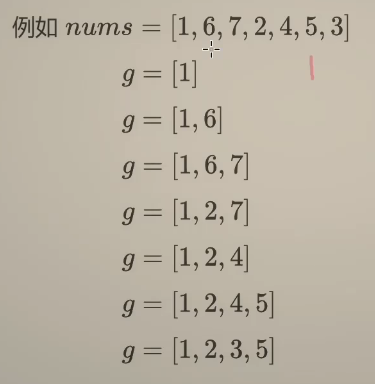
有以下结论:
- g是严格递增的
- 一次只能更新一个位置
- 更新的位置是第一个>=nums[i]的数的下标,若nums[i]比g的最后一个还大,那就加到末尾,这里可以用二分查找
1
2
3
4
5
6
7
8
9
10
11
12
13
14
15
16
17
18
19
20
21
22
23
24
25
26
27
28
29
30
31
32
33
34
35
36
37
38
39
| #include <bits/stdc++.h>
#define endl '\n'
using namespace std;
typedef long long ll;
typedef pair<int,int> PII;
const int N = 2e5 + 10;
const int mod = 1e9 + 7;
void solve() {
int n;
cin >> n;
vector<int> arr(n+1);
for (int i = 1;i<=n;i++) cin >> arr[i];
vector<int> g;
for (int i = 1;i<=n;i++){
auto j = lower_bound(g.begin(), g.end(),arr[i]);
if (j==g.end()) g.push_back(arr[i]);
else {
*j = arr[i];
}
}
cout << g.size();
}
int main()
{
ios::sync_with_stdio(0); cin.tie(0); cout.tie(0);
int tomorin=1;
while (tomorin--) solve();
return 0;
}
|