decltype
用法
该运算符可以获得一个变量或表达式的值的类型
语法:decltype(变量\表达式)
用于变量时,可以获得变量类型、引用类型、cv限定符
1
2
3
4
5
6
7
8
9
10
11
12
13
14
15
16
17
| int a = 3;
decltype(a) b = 5;
const int a = 3;
decltype(a) b = 5;
int a = 3;
int& b = a;
decltype(b) c = a;
struct s{
double a
};
decltype(s::a) a = 0.1;
s t;
decltype(t.a) a = 0.1;
|
用于表达式时:
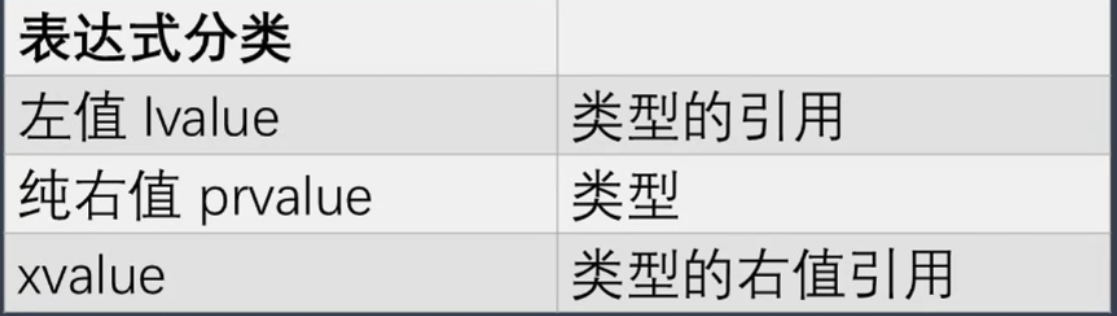
1
2
3
4
5
6
7
8
9
10
| int a;
decltype((a)) b = a;
string f1(){}
string& f2(){}
string&& f3(){}
decltype(f1()) s1;
decltype(f2()) s2 = s1;
decltype(f3()) s3 = "hello";
|
即推导函数正好是函数的返回值类型
注意:decltype中的表达式仅用于编译时的类型推导,不会真正执行
decltype(auto)
decltype(auto) 变量 = 初始值表达式替换后等同于
decltype(初始值表达式) 变量 = 初始值表达式
此时表达式是可以执行的
value_category
该类模板可以推导出所给的值属于左值、纯右值还是将亡值
经典用法:将表达式的类别表达出来
1
2
| #define VALUE_CATEGORY(expr) value_category<decltype((expr))>::value
#define CAT(a) std::cout <<"Category of "<< #a <<":"<<VALUE_CATEGORY(a)<<std::endl;
|
应用
常用于定义函数模板时,函数返回值的类型推到
1
2
3
4
5
6
| template <typename T, typename U>
decltype(auto) add(T&& t, U&& u){
return std::forward<T>(t)+std::forward<U>(u);
};
auto s = add(string("a"), string("b") )
|