并发编程
多个任务的执行方式
顺序:一个接着一个
并行:同一时间执行多个任务(并行是并发的子集)
并发:多个任务在同一个重叠时间段执行
OpenMP
使用#prgma预处理指令可以将代码转变为并行处理
此时需要在编译时添加参数-fopenmp
e.g. 计算
1 2 3 4 5 6 7 8 9 10 11 12 13 14 15 #include <iostream> using namespace std;double cal (const long num_steps) double step = 1.0 /num_steps; double sum = 0.0 ; #pragma omp parallel for reduction(+:sum) for (long i = 0 ; i<num_steps;i++){ double x = (i+0.5 )*step; sum+=4.0 /(1.0 +x*x); } return sum*step; } int main () cout << cal (10 ); }
其中第六行语句的意思:
omp parallel for表示将for循环每次循环转化为并行计算
reduction表示用于reduce计算的变量与运算符
局部变量x在每个线程中修改,不影响其他线程
sum是共享对象,不能在并行线程中直接修改,否则导致数据竞争
sum需要reduce操作,其中reduction表明了需要reduce操作的变量与运算符
STL并行算法库
使用<algorithm>与<numeric>库中的函数,可以简单实现并行
在支持并行的算法函数中,首个参数可以选择执行策略:
std::execution::sequenced_policy:顺序执行策略(实例:seq)std::execution::parallel_policy:并行执行策略(实例:par)std::execution::parallel_unsequenced_policy:多线程加向量化策略(实例:par_seq)
1 2 3 4 5 6 7 8 9 10 11 12 13 14 #include <algorithm> #include <iostream> #include <execution> #include <vector> int main () auto op = [](int v){std::cout << v << ";\n" ;}; std::vector<int > numbers{1 ,2 ,3 ,4 ,5 ,6 ,7 ,8 ,9 }; std::cout <<"sequential for_each" <<std::endl; for_each(std::execution::seq, numbers.begin (), numbers.end (), op); std::cout <<"parallel for_each" <<std::endl; for_each(std::execution::par, numbers.begin (), numbers.end (), op); std::cout <<"parallel unseq for_each" <<std::endl; for_each(std::execution::par_unseq, numbers.begin (), numbers.end (), op); }
以上没有对cout进行同步措施,会导致输出错误
线程
线程与进程
进程:程序执行过程,相互独立,操作系统为每一个进程分配一个执行控制块来控制进程
线程:进程中的执行过程,系统为每一个线程分配一个栈于线程控制块,线程间共享堆与全局数据
创建线程
使用<thread>类创建线程
thread(F&& f, Args&&... args);
第一个参数为线程的入口函数(线程函数),可以是各种可调用的对象
后面的Args为传递给可调用对象的实参
若第一个参数为非静态成员函数,则后面的第一个参数为调用这个成员函数的类对象地址
thread的返回值会被忽略,故要使用按引用传递的参数,或存储在类对象的数据成员中
用该函数初始化后会创建一个新线程,执行线程函数
线程只能移动构造或移动赋值 ,防止多个线程对象代表一个执行线程
.join()
该函数会使得当前线程执行结束后等待其他线程回会合,避免出现提前结束导致出现错误
这种等待状态称为阻塞 ,若对应线程提前结束,则join函数也会直接返回
调用函数时,该线程必须是joinable的,意味着该线程必须是正在执行或执行完毕但未合并的线程 ,可以使用.joinable()判断是否可合并
不能被合并的情况:
默认构造函数初始化的
join()完成的
detach()后的
被移动的
1 2 3 4 5 6 7 8 9 10 11 12 13 14 15 16 17 #include <thread> #include <iostream> #include <array> void greeting (int idx) printf ("Hello from thread %d\n" , idx); } int main () std::array<std::thread, 10> workers; for (int i = 0 ;i<10 ;i++){ workers[i] = std::thread (greeting, i); } for (auto &workers:workers){ workers.join (); } }
1
2
3
4
5
6
7
8
9
10
Hello from thread 0 Hello from thread 1 Hello from thread 2 Hello from thread 3 Hello from thread 4 Hello from thread 5 Hello from thread 6 Hello from thread 7 Hello from thread 8 Hello from thread 9
Fork and join
可以使用线程实现并行
通过Fork and
join模式:把要执行的数据分成n份,由n个线程并行处理自己的那部分数据,再进行汇总,n可以根据cpu核心设置
实现简单,但对于复杂计算,相同数据处理时间不同,导致有些线程很早处理完毕,有的需要更长时间结束
实现transform_reduce函数
1 2 3 4 5 6 7 8 9 10 11 12 13 14 15 16 17 18 19 20 21 22 23 24 25 26 27 28 29 30 31 32 33 34 35 36 37 38 39 40 41 42 43 #include <thread> #include <vector> #include <array> #include <iostream> template <typename Iter, typename UnaryOp, typename BinaryOp, typename Result>void transform_reduce (Iter first, Iter last, UnaryOp transform, BinaryOp reduce, Result& res) for (auto it=first;it<last;it++){ res = reduce (res, transform (*it)); } } int main () const int N = 1000000 ; std::vector<double > numbers; numbers.reserve (N); for (int i = 0 ; i < N; ++i) { numbers.push_back ((double )i/N); } auto transform = [](double x) { return x * x; }; auto reduce = [](double x, double y) { return x + y; }; const int N_thraeds = 8 ; std::vector<std::thread> workers; std::array<double , N_thraeds> subResults={}; for (int i = 0 ; i<N_thraeds; i++){ auto low = numbers.begin ()+i*numbers.size ()/N_thraeds; auto high = numbers.begin ()+(i+1 )*numbers.size ()/N_thraeds; workers.push_back ( std::thread ( transform_reduce<std::vector<double >::iterator, decltype (transform), decltype (reduce),double >, low, high, transform, reduce, std::ref (subResults[i]) ) ); } double result = 0 ; for (int i = 0 ; i < N_thraeds; ++i) { workers[i].join (); result = reduce (result,subResults[i]); } std::cout << "Result: " << result << std::endl; return 0 ; }
Divide and conquer
使用分治将一个任务分成两个小任务,由两个线程完成,然后小任务再分成两个小任务,创建两个线程完成,直到不能分解
另外需要设计一个阈值,当线程过多时就不再创建,而是使用同步计算
为了让各个线程任务饱满,可以采用一半采用同步调用,一半分给另一个线程
1 2 3 4 5 6 7 8 9 10 11 12 13 14 15 16 17 18 19 20 21 22 23 24 25 26 27 28 29 30 31 32 #include <thread> #include <vector> #include <array> #include <iostream> template <typename Iter, typename UnaryOp, typename BinaryOp, typename Result, std::size_t MinDist 10 >void transform_reduce (Iter first, Iter last, UnaryOp transform, BinaryOp reduce, Result& res) std::size_t distance = std::distance (first, last); if (distance==1 ){ res = reduce (res, transform (*first)); } else { std::size_t half = distance / 2 ; Iter middle = first+half; Result r_result = 0 ; Result l_result = 0 ; std::thread l_thread ( transform_reduce<Iter, UnaryOp, BinaryOp, Result>, first, middle, transform, reduce, std::ref(l_result) ) std::thread r_thread ( transform_reduce<Iter, UnaryOp, BinaryOp, Result>, middle, last, transform, reduce, std::ref(r_result) ) l_thread.join (); r_thread.join (); res = reduce (res, reduce (l_result, r_result)); } }
promise & future
这两个类提供了线程之间简单的通信机制
通过promise来设置值或异常,通过future来获得值或异常
一对promise&future共享一个shared
state(共享状态),是一个类对象,提供了在保证线程安全的情况下,设置和获取状态与结果的方法,使用shared_ptr指向该状态
常用于发送-接受模式中
promise
promise类模板提供了按值、按引用传递数据,以及仅传递信号三种版本
对应的成员函数:
promise():构造函数,创建一个共享状态
promise(promise&&
x):移动构造函数,将被移动对象x的共享状态转移过去
get_future():创建一个future对象,使用promise中的共享状态,只能调用一次
set_value():设置共享状态中的值,并设置为就绪状态
set_exception():设置共享状态的异常
注:为了保证一对一性,promise类删除了拷贝构造函数
1 2 3 4 5 6 7 8 9 10 11 12 13 14 15 16 17 18 19 20 21 22 23 24 25 26 27 #include <future> #include <iostream> void compute_pi (const long num_steps, std::promise<double >&& promise) double step = 1.0 / num_steps; double sum = 0.0 ; for (long i = 0 ; i < num_steps; ++i){ double x = (i + 0.5 ) * step; sum += 4.0 / (1.0 + x * x); } promise.set_value (sum * step); } void display (std::future<double >&& receiver) double pi = receiver.get (); std::cout << "Computed value of Pi: " << pi << std::endl; } int main () const int N_steps = 100000000 ; std::promise<double > promise; auto receiver = promise.get_future (); std::thread th1 (compute_pi, N_steps, std::move(promise)) ; std::thread th2 (display, std::move(receiver)) ; th1.join (); th2.join (); }
future
future中的方法主要用于获取状态与结果
get():获得结果,若对应结果没有处在就绪状态,那么这个调用会阻塞直到就绪
wait():等待状态就绪,之后返回,此时调用get可以直接获得结果
wait_for():等待指定时长,返回状态码
wait_until():等待到指定时刻,返回状态码
share():
状态码包括:
ready:共享状态就绪
timeout:超时
deferred:共享状态中有延缓执行的函数(显式请求中才会调用的函数)
若需要让多个线程获得结果,需要shared_future,构建方法如下:
定义对象,使用promise的get_future()作为初始化参数
在原有future上调用方法.share(),此时原有不再使用
1 2 3 4 5 6 7 8 9 10 11 12 13 14 15 16 17 18 19 20 21 22 23 24 25 26 27 28 29 30 31 #include <future> #include <iostream> #include <sstream> void compute_pi (const long num_steps, std::promise<double >&& promise) double step = 1.0 / num_steps; double sum = 0.0 ; for (long i = 0 ; i < num_steps; ++i){ double x = (i + 0.5 ) * step; sum += 4.0 / (1.0 + x * x); } promise.set_value (sum * step); } void display (std::shared_future<double > reveiver) static std::mutex mu; double pi = reveiver.get (); printf ("Computed value of Pi: %f\n" , pi); } int main () const int N_steps = 100000000 ; std::promise<double > promise; std::shared_future<double > shared_receiver (promise.get_future()) ; std::thread th1 (compute_pi, N_steps, std::move(promise)) ; std::thread th2 (display, shared_receiver) ; std::thread th3 (display, shared_receiver) ; th1.join (); th2.join (); th3.join (); }
互斥和锁
多线程中,当多个线程队同一个对象进行访问,并且至少有一个在写数据时,会产生数据竞争
1 2 3 4 5 6 7 8 9 10 11 12 13 14 15 16 17 18 19 #include <array> #include <thread> #include <iostream> void inc (int &res) for (int i = 0 ; i < 1000000 ; ++i){ res++; } } int main () int counter = 0 ; std::thread th1 (inc, std::ref(counter)) ; std::thread th2 (inc, std::ref(counter)) ; th1.join (); th2.join (); std::cout << "Counter: " << counter << std::endl; }
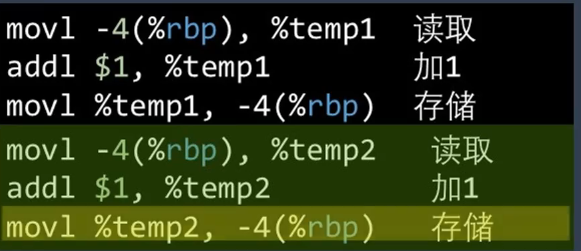
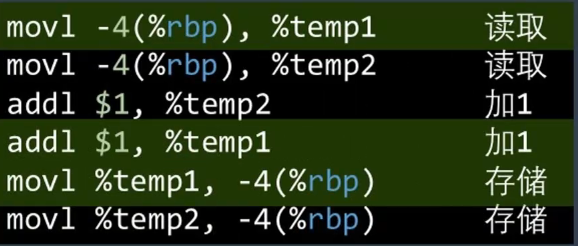
该程序创建了两个线程进行累加,但最后得到的结果都不是正确结果,且每次都不一样
这是一个正常的执行过程
若顺序是这样结果就不对了
互斥量
C++中所有运算默认为非原子操作 ,即该线程操作随时会被终端或被其他线程访问
mutex提供了一种同步机制,实现多个线程的安全访问
C++11开始,提供了std::mutex来实现互斥原语,是最常用的同步原语之一
有三个主要函数:
lock():锁定互斥量,即获得互斥量,若已经被其他线程锁定,则会进入阻塞直到被解锁
try_lock():尝试锁定互斥量,若成功锁定则返回true,否则返回false(不保证被其他线程锁定)
unlock():解锁,释放互斥量
1 2 3 4 5 6 7 8 9 10 11 12 13 14 15 16 17 18 19 20 21 22 23 24 25 26 27 28 29 30 31 32 33 34 35 36 37 38 39 40 #include <array> #include <thread> #include <iostream> #include <mutex> class counter {public : void inc () counter_mutex.lock (); m_count++; counter_mutex.unlock (); } int get () int temp; counter_mutex.lock (); temp = m_count; counter_mutex.unlock (); return temp; } private : int m_count = 0 ; std::mutex counter_mutex; }; int main () counter c; auto increase = [](counter &c){ for (int i = 0 ; i < 1000000 ; ++i){ c.inc (); } }; std::thread th1 (increase, std::ref(c)) ; std::thread th2 (increase, std::ref(c)) ; th1.join (); th2.join (); std::cout << "Counter: " << c.get () << std::endl; }
其中,被mutex保护的操作区域叫做临界区
为了避免未释放互斥量的问题,我们通常结合以下对象使用
lock_guard():可以通过调用上锁后自动解锁,防止忘记解锁以及出现异常离开作用域时没有解锁
1
2
3
4
5
6
7
8
9
10
11
12
13
14
class counter {public : void inc () std::lock_guard lock (counter_mutex) ; m_count++; } int get () std::lock_guard lock (counter_mutex) ; return m_count; } private : int m_count = 0 ; std::mutex counter_mutex; };
unique_lock():更加灵活,可以随时指定锁定与解锁
1 2 3 4 5 6 7 8 9 10 11 12 13 14 15 16 17 18 19 20 21 22 23 24 25 26 27 28 29 30 31 32 33 34 35 #include <array> #include <thread> #include <iostream> #include <mutex> class counter {public : void inc (int n) std::unique_lock lock (counter_mutex, std::defer_lock) ; while (n--){ lock.lock (); m_count++; lock.unlock (); } } int get () std::unique_lock lock (counter_mutex) ; return m_count; } private : int m_count = 0 ; std::mutex counter_mutex; }; int main () counter c; auto increase = [](counter &c){ c.inc (1000000 ); }; std::thread th1 (increase, std::ref(c)) ; std::thread th2 (increase, std::ref(c)) ; th1.join (); th2.join (); std::cout << "Counter: " << c.get () << std::endl; }
timed_mutex:有等待时长的互斥
try_lock_for():指定时长内获得mutex的所有权
try_lock_until():指定时刻前获得mutex的所有权
返回true表明获得mutex,否则返回false
1 2 3 4 5 6 7 8 9 10 11 12 13 14 15 16 17 18 19 20 21 22 23 24 25 26 27 28 29 30 31 32 33 34 35 36 37 38 39 40 41 42 43 44 45 #include <mutex> #include <thread> #include <iostream> #include <chrono> #include <sstream> using namespace std::chrono_literals;class TryDemo {public : void print () for (int i = 0 ; i<10 ; i++){ std::unique_lock lock (m_mutex, std::defer_lock) ; if (lock.try_lock_for(100 ms)) { { std::lock_guard guard (cout_mutex) ; std::cout <<"[" <<std::this_thread::get_id ()<<"] " << "Got the lock, printing " << i << std::endl; } std::this_thread::sleep_for (100 ms); } else { std::lock_guard guard (cout_mutex); std::cout <<"[" <<std::this_thread::get_id ()<<"] " << "Failed to get the lock, skipping " << i << std::endl; std::this_thread::sleep_for (100 ms); } } } private : std::timed_mutex m_mutex; std::mutex cout_mutex; int m_count = 0 ; }; int main () TryDemo demo; auto print = [](TryDemo &demo){ demo.print (); }; std::thread th1 (print, std::ref(demo)) ; std::thread th2 (print, std::ref(demo)) ; th1.join (); th2.join (); }
1
2
3
4
5
6
7
8
9
10
11
12
13
14
15
16
17
18
19
20
[2] Got the lock, printing 0 [3] Failed to get the lock, skipping 0 [2] Got the lock, printing 1 [3] Failed to get the lock, skipping 1 [2] Got the lock, printing 2 [3] Failed to get the lock, skipping 2 [2] Got the lock, printing 3 [3] Failed to get the lock, skipping 3 [2] Got the lock, printing 4 [3] Failed to get the lock, skipping 4 [2] Got the lock, printing 5 [2] Got the lock, printing 6 [3] Failed to get the lock, skipping 5 [3] Got the lock, printing 6 [3] Got the lock, printing 7 [2] Failed to get the lock, skipping 7 [2] Got the lock, printing 8 [3] Failed to get the lock, skipping 8 [2] Got the lock, printing 9 [3] Failed to get the lock, skipping 9
死锁
单一线程中多次锁定同一个互斥量会导致死锁
常见死锁:
1 2 3 4 5 6 7 8 9 10 11 12 13 14 15 16 17 18 19 20 21 22 23 #include <iostream> #include <mutex> #include <thread> class dosome {public : int f1 () std::lock_guard lock (mtx) ; count*=2 ; f2 (); return count; } void f2 () std::lock_guard (mtx); count++; } private : std::mutex mtx; int count=0 ; };
此时所在线程会进入阻塞状态
我们使用`recursive的mutx优化
1 2 3 4 5 6 7 8 9 10 11 12 13 14 15 16 17 18 19 20 21 22 23 #include <iostream> #include <mutex> #include <thread> class dosome {public : int f1 () std::lock_guard lock (mtx) ; count*=2 ; f2 (); return count; } void f2 () std::lock_guard (mtx); count++; } private : std::recursive_mutex mtx; int count=0 ; };
当被锁定并获得互斥量后,当前线程再调用lock后仍会成功而不会阻塞,直到调用相同数量的unlock()才会被释放
多线程中
多线程中,导致死锁原因较多
锁定一个互斥量后没有释放,导致后面的线程获取该互斥量时进入阻塞状态
解决方法:使用RAII ,即使用lock_guard等自动对象,在离开作用域后自动释放互斥量
同时对多个互斥量锁定解锁时,获得和释放顺序不同导致死锁
如以下代码
1 2 3 4 5 6 7 8 9 10 11 12 13 14 15 16 17 18 19 20 21 22 23 24 25 26 27 28 29 30 31 32 33 34 35 36 37 38 39 40 41 42 43 44 45 46 47 48 49 50 51 52 53 54 #include <iostream> #include <mutex> #include <thread> #include <chrono> using namespace std::chrono_literals;class dosome {public : void f1 () { std::lock_guard lock1 (mtx1) ; std::lock_guard lock2 (cout_mtx) ; count++; std::cout << "count: " <<count<<std::endl; } std::this_thread::sleep_for (1 ms); } void f2 () { std::lock_guard lock1 (cout_mtx) ; std::lock_guard lock2 (mtx1) ; count--; std::cout << "count: " <<count<<std::endl; } std::this_thread::sleep_for (1 ms); } void calc (int n) for (int i = 0 ;i<n;i++){ if (n%2 ){ f2 (); } else { f1 (); } } } private : std::mutex mtx1; std::mutex cout_mtx; int count=0 ; }; int main () dosome d; const int N1 = 10000 ; const int N2 = 10001 ; std::thread th1 (dosome::calc, &d, N1) ; std::thread th2 (dosome::calc, &d, N2) ; th1.join (); th2.join (); }
这里f1与f2都对两个互斥量进行锁定,顺序不同
主函数设置两个线程分别为10000次,执行f1,10001次,执行f2
此时运行程序会在一定时间发生死锁:
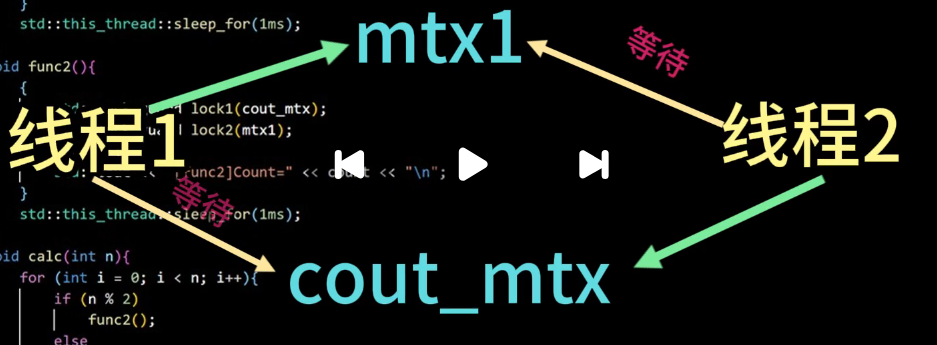
线程1在某个时刻获得了mtx1,线程2在下一时刻获得了cout_mtx
接下来线程1需要获得cout_mtx,但已被2占有,需要进入阻塞等待资源释放
同时线程2需要获得mtx1,但已被1占有,需要进入阻塞等待资源释放
故整个程序进入阻塞,无法执行
活锁
对于上述问题,解决方法之一是使用timed_mutex+try_lock_for
1 2 3 4 5 6 7 8 9 10 11 12 13 14 15 16 17 18 19 20 21 22 23 24 25 26 27 28 29 30 31 32 33 34 35 36 37 38 39 40 41 42 43 44 45 46 47 48 49 50 51 52 53 54 55 56 57 #include <iostream> #include <mutex> #include <thread> #include <chrono> using namespace std::chrono_literals;class dosome {public : void f1 () while (1 ){ std::unique_lock lock1 (mtx1, std::defer_lock) ; std::unique_lock lock2 (cout_mtx, std::defer_lock) ; if (!lock1.try_lock_for(100 ms)) continue ; if (!lock2.try_lock_for(100 ms)) continue ; count++; std::cout << "count: " <<count<<std::endl; break ; } } void f2 () while (1 ){ std::unique_lock lock1 (cout_mtx, std::defer_lock) ; std::unique_lock lock2 (mtx1, std::defer_lock) ; if (!lock1.try_lock_for(100 ms)) continue ; if (!lock2.try_lock_for(100 ms)) continue ; count--; std::cout << "count: " <<count<<std::endl; break ; } } void calc (int n) for (int i = 0 ;i<n;i++){ if (n%2 ){ f2 (); } else { f1 (); } } } private : std::timed_mutex mtx1; std::timed_mutex cout_mtx; int count=0 ; }; int main () dosome d; const int N1 = 10000 ; const int N2 = 10001 ; std::thread th1 (dosome::calc, &d, N1) ; std::thread th2 (dosome::calc, &d, N2) ; th1.join (); th2.join (); }
但是运行起来会出现一顿一顿的情况
此时程序进入了一种活锁 的状态,即
线程1锁定mtx1,线程2锁定cout_mtx
线程1试图锁定cout_mtx1失败,进入阻塞,超时后释放mtx1进入下个循环,
线程2试图锁定mtx1失败,进入阻塞,超时后释放cout_mtx进入下个循环
以此类推
防止该情况的发生,需要注意调用次序,注意保证按照顺序获得互斥量
更加方便的方法是使用std::lock()函数或scope_lock类统一管理多个互斥量
lock函数
1 2 3 4 5 6 7 8 9 10 11 12 13 14 15 16 17 18 19 20 21 22 23 24 25 26 27 28 29 30 31 32 33 34 35 36 37 38 39 40 41 42 43 44 45 46 47 48 49 50 51 52 53 #include <iostream> #include <mutex> #include <thread> #include <chrono> using namespace std::chrono_literals;class dosome {public : void f1 () { std::lock (mtx1, cout_mtx); std::lock_guard lock1 (mtx1, std::adopt_lock) ; std::lock_guard lock2 (cout_mtx, std::adopt_lock) ; count++; std::cout << "count: " <<count<<std::endl; } } void f2 () { std::lock (mtx1, cout_mtx); std::lock_guard lock1 (cout_mtx, std::adopt_lock) ; std::lock_guard lock2 (mtx1, std::adopt_lock) ; count--; std::cout << "count: " <<count<<std::endl; } } void calc (int n) for (int i = 0 ;i<n;i++){ if (n%2 ){ f2 (); } else { f1 (); } } } private : std::mutex mtx1; std::mutex cout_mtx; int count=0 ; }; int main () dosome d; const int N1 = 10000 ; const int N2 = 10001 ; std::thread th1 (dosome::calc, &d, N1) ; std::thread th2 (dosome::calc, &d, N2) ; th1.join (); th2.join (); }
此时lock函数会接管下面的两个lock_guard,当他们被销毁时,析构函数中会自动释放两个互斥量
即使传入的两个互斥量顺序不同,lock的特殊算法也可避免死锁的发生
scope_lock类
该类更加方便,使用多个类进行初始化
构造时可以自动调用lock函数,析构时自动释放
1 2 3 4 5 6 7 8 9 10 11 12 13 14 15 16 17 18 19 20 21 22 23 24 25 26 27 28 29 30 31 32 33 34 35 36 37 38 39 40 41 42 43 44 45 46 47 48 49 #include <iostream> #include <mutex> #include <thread> #include <chrono> using namespace std::chrono_literals;class dosome {public : void f1 () { std::scoped_lock lock (mtx1, cout_mtx) ; count++; std::cout << "count: " <<count<<std::endl; } } void f2 () { std::scoped_lock lock (cout_mtx, mtx1) ; count--; std::cout << "count: " <<count<<std::endl; } } void calc (int n) for (int i = 0 ;i<n;i++){ if (n%2 ){ f2 (); } else { f1 (); } } } private : std::mutex mtx1; std::mutex cout_mtx; int count=0 ; }; int main () dosome d; const int N1 = 10000 ; const int N2 = 10001 ; std::thread th1 (dosome::calc, &d, N1) ; std::thread th2 (dosome::calc, &d, N2) ; th1.join (); th2.join (); }
读写锁
若存在三个线程读取数据、一个线程写入数据,若使用mutex互斥量进行操作,读写步骤几乎是排队进行的,导致了程序运行效率底下
我们又知道,在没有数据写入的情况下,多个线程同时读取数据是不会发生数据竞争的,不必独占资源
故我们可以规定:
一个线程读取数据时,允许其他线程同时读取数据,不允许其他线程写数据
一个线程写数据时,不允许其他线程读写数据
这样可以显著提高效率
C++14以上,这样的读写锁的功能由shared_mutex类、shared_timed_mutex提供
该类提供两个模式和两个锁:
独占模式:仅有一个线程可以占有互斥量
独占锁:独占模式下,当一个线程获得独占锁,任何其他线程都不能获得独占锁和共享锁
共享模式:可以有多个线程分享互斥量
共享锁:共享模式下,当一个线程获得共享锁,其他线程可获得共享锁,不能获得独占锁
读写锁广泛应用于读多写少的场景下,是一种重要的同步原语
条件变量
条件变量是并发程序中经常用到的同步原语,可以实现在线程间发生通知以实现线程间的同步
工作流
如提供两个线程,用于读取与写入数据,读取要在写入之后
接收线程获得互斥量mutex,使用条件变量来等待发送线程的通知,等待时释放mutex
发送线程获得mutex,并对共享数据进行写入,完成后释放mutex
发送线程使用条件变量发送通知,接收线程接收到通知后重新获得mutex,结束阻塞继续运行
接收线程读取处理共享数据,处理完毕后释放mutex
使用
标准库conditional_variable实现条件变量原语,包含以下函数:
等待:
wait:传入锁的引用以及解除阻塞的条件。进入等待状态时释放锁,结束后获得锁,且都是原子操作
wait_for:
wait_until:
通知:
例
1 2 3 4 5 6 7 8 9 10 11 12 13 14 15 16 17 18 19 20 21 22 23 24 25 26 27 28 29 30 31 32 33 34 35 36 37 38 39 40 41 42 43 #include <iostream> #include <thread> #include <mutex> #include <chrono> #include <condition_variable> using namespace std::chrono_literals;class channel {public : void getData () auto tid = std::this_thread::get_id (); std::unique_lock lck (mutex_) ; std::cout<<"接收方[" <<tid<<"]等待数据" <<std::endl; condVar.wait (lck); std::cout<<"接收方[" <<tid<<"]得到数据" <<sharedData<<std::endl; sharedData.clear (); } void setData () static int id = 1 ; std::stringstream ss; ss << "hello #" <<id; { std::unique_lock lck (mutex_) ; sharedData = ss.str (); std::cout <<"\n发送方:第" <<id<<"条数据写入完毕" <<std::endl; id++; } condVar.notify_one(); std::this_thread::sleep_for (1 ms); } private : std::mutex mutex_; std::condition_variable condVar; std::string sharedData; }; int main () channel c; std::thread write_th (channel::setData, &c) ; std::thread read_th (channel::getData, &c) ; read_th.join (); write_th.join (); }
丢失唤醒与虚假唤醒
发现程序运行时,有时会出现死锁的状态
从输出发现,写线程在读线程进入等待前就准备好了数据并发出通知,而读线程进入状态后才
准备接受通知,于是错过了通知,一直等待,发生丢失唤醒
除了丢失唤醒,等待函数还会出现虚假唤醒:即等待线程在条件未满足的情况下被唤醒了
原因与底层硬件软件的异常有关
因此我们最好使用wait函数的重载版本,设置一个等待条件
1 2 3 4 5 6 7 8 9 10 11 12 13 14 15 16 17 18 19 20 21 22 23 24 25 26 27 28 29 30 31 32 33 34 35 36 37 38 39 40 41 42 43 44 45 46 #include <iostream> #include <thread> #include <mutex> #include <chrono> #include <condition_variable> using namespace std::chrono_literals;class channel {public : void getData () auto tid = std::this_thread::get_id (); std::unique_lock lck (mutex_) ; std::cout<<"接收方[" <<tid<<"]等待数据" <<std::endl; condVar.wait (lck, [this ]{return !sharedData.empty ();}); if (sharedData.empty ()){ std::cout<<"接收方[" <<tid<<"] 虚假唤醒" <<std::endl; } else std::cout<<"接收方[" <<tid<<"]得到数据" <<sharedData<<std::endl; sharedData.clear (); } void setData () static int id = 1 ; std::stringstream ss; ss << "hello #" <<id; { std::unique_lock lck (mutex_) ; sharedData = ss.str (); std::cout <<"\n发送方:第" <<id<<"条数据写入完毕" <<std::endl; id++; } condVar.notify_one(); std::this_thread::sleep_for (1 ms); } private : std::mutex mutex_; std::condition_variable condVar; std::string sharedData; }; int main () channel c; std::thread write_th (channel::setData, &c) ; std::thread read_th (channel::getData, &c) ; read_th.join (); write_th.join (); }
信号量
实现对有限资源的并发访问控制,内部有一个计数器,表示资源的可用数量
线程通过信号量来获得对资源的访问许可,若大于0,可以进行访问,计数器减一
信号量要与互斥量结合使用,用信号量来限制并发访问数量,用互斥量实现对具体数据同步
C++标准库中,有一个类模板counting_semaphore,其中参数LeastMaxValue规定了计数最大值不小于该值,还有他的特化版本binary_semaphore,值设定为1
函数:
release:将计数值+1,是原子操作
acquire:若计数值大于1,则将计数值-1,如果为0,则该函数阻塞直到计数值大于1
try_acquire:成功时将计数值-1,返回true
try_acquire_for:阻塞时最多等待的时间
try_acquire_until:阻塞时最多等待到某个时刻
例:循环读写buffer
1 2 3 4 5 6 7 8 9 10 11 12 13 14 15 16 17 18 19 20 21 22 23 24 25 26 27 28 29 30 31 32 33 34 35 36 37 38 39 40 41 42 43 44 45 46 47 48 49 50 51 52 53 54 55 56 57 58 59 60 61 62 63 64 65 66 67 68 69 70 71 72 73 74 75 76 77 78 79 80 81 82 83 84 85 86 87 88 89 90 91 92 93 94 95 96 97 98 99 100 101 102 103 104 105 106 107 108 109 110 111 112 113 114 #include <iostream> #include <thread> #include <chrono> #include <random> #include <array> #include <semaphore> #include <syncstream> class Random {public : Random (int l, int r) : eng (std::random_device{}()), dist (l, r) {} int operator () () return dist (eng); } private : std::mt19937 eng; std::uniform_int_distribution<int > dist; }; template <size_t BuffSize = 6 >class RWBuffer {public : RWBuffer () { buff.fill (' ' ); } char prepareData () std::this_thread::sleep_for (std::chrono::milliseconds (rgen ())); return chargen (); } void processData (char ) std::this_thread::sleep_for (std::chrono::milliseconds (rgen2 ())); } void printBuffer () std::osyncstream sync (std::cout) ; sync << "BUFFER: |" ; for (auto c : buff) { sync << c << "|" ; } sync << "\n" ; } void writeToBuffer (size_t iterations) std::osyncstream (std::cout) << "写线程就绪.\n" ; for (size_t i = 0 ; i < iterations * BuffSize; i++) { char ch = prepareData (); sem_writer.acquire (); size_t idx = i % BuffSize; buff[idx] = ch; std::osyncstream (std::cout) << "写线程:写入 '" << ch << "' 到位置 " << idx << "\t" ; printBuffer (); sem_reader.release (); } } void readFromBuffer (size_t iterations) std::osyncstream (std::cout) << "读线程就绪.\n" ; for (size_t i = 0 ; i < iterations * BuffSize; i++) { sem_reader.acquire (); size_t idx = i % BuffSize; char ch = buff[idx]; processData (ch); buff[idx] = ' ' ; std::osyncstream (std::cout) << "读线程:读取 '" << ch << "' 从位置 " << idx << "\t" ; printBuffer (); sem_writer.release (); } } private : Random rgen{500 ,1000 }; Random rgen2{800 ,1500 }; Random chargen{'A' ,'Z' }; std::array<char , BuffSize> buff; std::counting_semaphore<BuffSize> sem_reader{0 }; std::counting_semaphore<BuffSize> sem_writer{BuffSize}; }; int main () constexpr size_t N = 6 ; constexpr size_t ITERS = 3 ; RWBuffer<N> buffer; std::thread writer (&RWBuffer<N>::writeToBuffer, &buffer, ITERS) ; std::thread reader (&RWBuffer<N>::readFromBuffer, &buffer, ITERS) ; writer.join (); reader.join (); return 0 ; }
异步任务
将函数调用交给另一个线程异步执行,原有线程继续执行代码,在需要时再去获得执行结果
C++中提供了async与packaged_task进行异步任务
async
语法:
std::future<返回类型> async(std::launch policy, F& f, Args&&... args);
std::future<返回类型> async(F& f, Args&&... args);(默认策略)
执行策略(用整型不同bit位表示):
std::launch::async:异步调用,00000001,相当于新建或使用线程池中的线程并在线程中调用函数std::launch::deferred:推迟调用,00000010,async返回的future对象用于存储函数指针、对象、实参拷贝,调用get函数时会同步调用存储的这个函数std::launch::async|std::launch::deferred:组合,00000011,同步还是异步执行根据具体实现决定
packaged_task
方法
get_future():获得一个future对象,封装函数的返回结果存储在future对象的共享状态中
void operator()(ArgTypes... args):用于调用封装的函数,将返回结果存储在future中,此时会同步执行封装函数reset():用于重复使用packaged_task,清空状态获得一个新的future对象
1 2 3 4 5 6 7 8 9 10 11 12 13 14 15 16 17 18 19 20 21 22 23 24 25 26 27 28 29 30 31 32 33 34 35 36 37 38 39 40 41 42 43 44 45 46 47 48 49 50 51 #include <iostream> #include <thread> #include <random> #include <vector> #include <future> #include <syncstream> class Random {public : Random (int l, int r) : eng (std::random_device{}()), dist (l, r) {} int operator () () return dist (eng); } private : std::mt19937 eng; std::uniform_int_distribution<int > dist; }; float Compute (std::vector<float > &v) std::this_thread::sleep_for (std::chrono::seconds (2 )); auto r = std::accumulate (v.begin (), v.end (), 0.0f ); std::osyncstream (std::cout)<<"执行任务的线程id=" <<std::this_thread::get_id ()<<std::endl; return r; } int main () const int RN_MAX = 10000 ; Random rgen (0 , RN_MAX) ; std::vector<float > numbers (100 , 0.0f ) ; std::generate (numbers.begin (), numbers.end (), [&]{return float (rgen ()/RN_MAX);}); std::cout <<"创建任务的线程id:" <<std::this_thread::get_id ()<<std::endl; std::packaged_task<float (std::vector<float >&)> task (Compute); std::cout<<"直接调用" <<std::endl; std::future<float > result = task.get_future (); task (numbers); std::cout <<"result=" <<result.get ()<<std::endl; task.reset (); std::cout<<"线程调用" <<std::endl; result = task.get_future (); std::thread t (std::move(task), std::ref(numbers)) ; std::cout<<"result=" <<result.get ()<<std::endl; t.join (); return 0 ; }
线程屏障
线程屏障提供了一个计数器,每个参与任务的线程完成自己的任务后计数器-1,而需要同步的线程可以阻塞到计数器为0时再执行后面的代码
latch
latch是一次性的计数,参数为作为计数器的初始值
count_down(n=1):将计数器减去传入的数值,默认为1,是原子操作
wait():将线程阻塞到计数器为0后释放
try_wait():检查计数器是否为0,返回true为0,返回false不一定为0
arrive_and_wait(n=1):执行了count_down和wait
e.g.模拟paobu
1 2 3 4 5 6 7 8 9 10 11 12 13 14 15 16 17 18 19 20 21 22 23 24 25 26 27 28 29 30 31 32 33 34 35 36 37 38 39 40 41 42 43 44 45 46 47 48 49 50 51 52 #include <iostream> #include <thread> #include <latch> #include <random> #include <chrono> struct Runner { std::string name; int time = 0 ; void run (std::latch& start, std::latch& end) start.wait (); auto start_time = std::chrono::system_clock::now (); std::mt19937 rng (std::random_device{}()) ; std::uniform_int_distribution<unsigned int > uniform_dist (0 , 2000 ) ; std::this_thread::sleep_for (std::chrono::milliseconds (9600 +uniform_dist (rng))); auto end_time = std::chrono::system_clock::now (); time = std::chrono::duration_cast <std::chrono::milliseconds>(end_time - start_time).count (); end.count_down (1 ); } bool operator <(const Runner& other) const { return time < other.time; } }; int main () std::vector<Runner> runners = { {"Alice" }, {"Bob" }, {"Charlie" }, {"Diana" }, {"Eve" } }; const int runner_count = runners.size (); std::latch start (1 ) ; std::latch finish (runner_count) ; std::vector<std::thread> threads; for (int i = 0 ; i<runner_count; ++i) { threads.emplace_back (&Runner::run, &runners[i], std::ref (start), std::ref (finish)); } std::cout <<"发令枪响" << std::endl; start.count_down (); finish.wait (); std::cout <<"比赛结束" << std::endl; std::sort (runners.begin (), runners.end ()); for (const auto & runner : runners) { std::cout << runner.name << " : " << float (runner.time)/1000 << "秒" << std::endl; } for (auto & thread : threads) { thread.join (); } }
1
2
3
4
5
6
7
发令枪响 比赛结束 Eve : 9.946秒 Bob : 10.034秒 Diana : 10.092秒 Alice : 10.842秒 Charlie : 11.621秒
barrier
barrier每次计数到0时,都会把初始值恢复,进行下一轮计数
barrier是个类模板,参数为计数器初始值
1 2 3 4 5 6 7 8 9 10 11 12 13 14 15 16 17 18 19 20 21 22 23 24 25 26 27 28 29 30 31 32 33 34 35 36 37 38 39 40 41 42 43 44 45 46 47 48 49 50 51 52 53 54 55 56 57 58 59 60 61 62 63 64 65 66 67 68 #include <iostream> #include <thread> #include <barrier> #include <random> #include <chrono> #include <vector> class participant {public : std::string name; participant (const std::string& name) : name (name) {} template <typename BarrierType> void run (BarrierType& finish) std::mt19937 rng (std::random_device{}()) ; std::uniform_int_distribution<unsigned int > uniform_dist (1000 , 2000 ) ; for (int i = 0 ; i<5 ;i++){ auto rnd = uniform_dist (rng); std::this_thread::sleep_for (std::chrono::milliseconds (rnd)); alive = rnd%3 ; if (alive){ finish.arrive_and_wait (); } else { finish.arrive_and_drop (); break ; } } } bool is_alive () const return alive; } private : bool alive = true ; }; int main () std::vector<participant> participants = { {"Alice" }, {"Bob" }, {"Charlie" }, {"Diana" }, {"Eve" } }; const int participant_count = participants.size (); int round = 0 ; auto on_complete = [&participants, &round](){ round++; std::cout <<"第" << round << "轮幸存者:" << std::endl; int count = 0 ; for (auto & p : participants) { if (p.is_alive ()) { std::cout << p.name << " " ; count++; } } if (count==0 ){ std::cout << "没有幸存者" << std::endl; } std::cout << std::endl; }; std::barrier finish (participant_count, on_complete) ; std::vector<std::thread> threads; for (auto &p: participants) { threads.emplace_back ([&p, &finish](){p.run (finish);}); } for (auto &thread : threads) { thread.join (); } return 0 ; }
注:对计数器进行-n操作时,传入的n的值不能大于当前计数值,否则会导致未定义错误
原子操作
原子操作是不能被分割或中断的操作,其他线程只能看到开始与结束的状态
类型
Load 加载
Store 存储
Read Modify Write 读取-修改-写入(RMW)
atomic_flag
它只有true和false两个值,true表示标志被设置,false表示标志被清除
初始化可以使用ATOMIC_FLAG_INIT宏,也可以使用默认构造函数(C++20后)
(以下为C++20新增)
test():读取数据
wait(oldvalue):等待条件达成
notify_one():通知其中一个线程结束等待
notify_all():通知所有线程结束等待
自旋锁
自旋:持续监控变量以等待发生变化的过程
自旋锁消耗资源较高,常用于临界区代码耗时很少的场合
1
2
3
4
5
6
7
8
9
10
11
class SpinLock {public : void lock () while (flag.test_and_set (std::memory_order_acquire)){} } void unlock () flag.clear (std::memory_order_release); } private : std::atomic_flag flag{ATOMIC_FLAG_INIT}; };
例:
1 2 3 4 5 6 7 8 9 10 11 12 13 14 15 16 17 18 19 20 21 22 23 24 25 26 27 28 29 30 31 #include <iostream> #include <atomic> #include <thread> #include <assert.h> class SpinLock {public : void lock () while (flag.test_and_set (std::memory_order_acquire)){} } void unlock () flag.clear (std::memory_order_release); } private : std::atomic_flag flag{ATOMIC_FLAG_INIT}; }; int main () SpinLock spin; int count = 0 ; auto inc = [&](){ for (int i = 0 ; i<1000 ;i++){ std::lock_guard<SpinLock> lock (spin); ++count; } }; std::thread t1 (inc) ; std::thread t2 (inc) ; t1.join (); t2.join (); std::cout << "count = " << count << std::endl; }
这里由于自旋锁包含lock与unlock函数,符合C++中的基本锁类型,故可以使用lock_guard自动加锁解锁
例
实现了一个一次生产者与消费者的模拟
1 2 3 4 5 6 7 8 9 10 11 12 13 14 15 16 17 18 19 20 21 22 23 24 25 26 27 28 29 30 31 32 33 34 #include <iostream> #include <atomic> #include <thread> #include <assert.h> struct Channel { void getData () std::cout <<"[Consumer] wait for data ready\n" ; dataReady.wait (false ); std::cout<<"[Consumer] data is:" <<data<<std::endl; dataReady.clear (); } void setData (const std::string& v) std::this_thread::sleep_for (std::chrono::milliseconds (2000 )); std::cout<< "'[Producer] write data\n" ; data = v; dataReady.test_and_set (); dataReady.notify_one(); } private : std::atomic_flag dataReady = ATOMIC_FLAG_INIT; std::string data; }; int main () Channel channel; std::thread consumer (Channel::getData, &channel) ; std::thread producer (Channel::setData, &channel, "Hello, World!" ) ; consumer.join (); producer.join (); }
特化版本
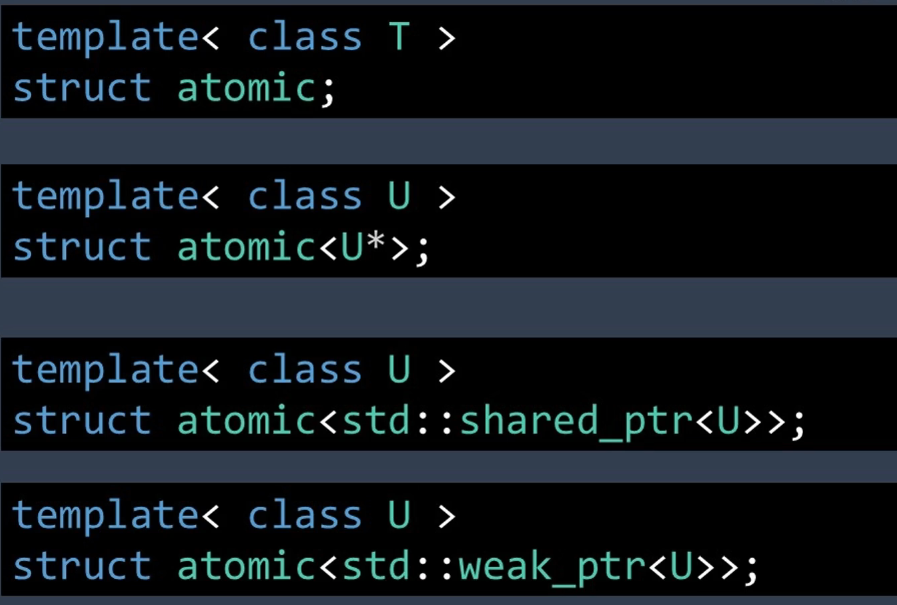
atomic除了主模板还有针对指针、智能指针与数据类型的特化版本
其中主模板中的T要求是可平凡拷贝的
有无锁的判断
我们可以通过atomic模板提供的is_lock_free()函数判断有无锁,若无锁(通过CPU的原子指令)则函数返回true,否则返回false
基本类型和指针都是无锁的
自定义类型与类型大小与对齐有关:类型大小是
主要的原子操作
加载操作: 用于原子地获得当前变量的值
1
2
T load (std::memory_order order = std::memory_order_seq_cst) const noexcept ;operator T () const noexcept
存储操作: 用于将变量原子地修改为要更新的值
1
2
void store (T desired, std::memory_order order = std::memory_order_seq_cst) noexcept T operator =(T desired) noexcept ;
CAS(比较与交换函数):
通过compare_exchange函数完成
1
2
bool compare_exchange_weak (T& expected, T desired, std::memory_order success, std::memory_order failure) noexcept bool compare_exchange_strong (T& expected, T desired, std::memory_order success, std::memory_order failure) noexcept
符合条件的CAS会直接使用CPU硬件指令来实现
其中weak版可能有虚假失败的情况
例:CAS循环模式
CAS是实现无锁算法的重要方式,经常使用CAS循环实现对原子值更改
1
2
3
4
5
6
7
8
9
int fetch_multiply (std::atomic<int > &value, int multiplier) int oldValue = value.load (); int desire; do { desired = oldValue*multiplier; }while (!value.compare_exchange_strong (oldValuem desired)); return oldValue; }
原理:加载当前值到oldValue,使用其来计算乘积并存储到本地变量desire,调用compare_exchange以原子方式更新value
若原value等于oldValue,说明没有并发线程修改过value,则更新为desired
若不等与则说明value被其他线程修改,那么将oldValue的值更新为当前value重试
例:使用atomic和CAS实现无锁堆栈
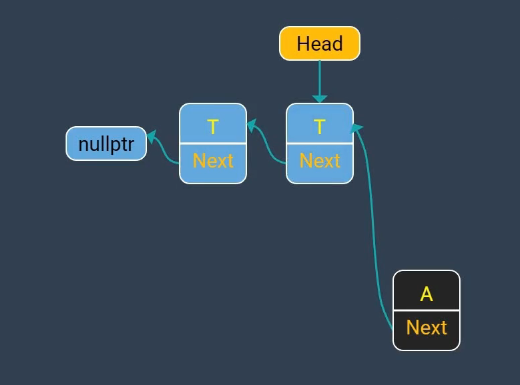
在多线程模式下,将新节点的next指向原节点与将head节点指向新节点是两个独立操作,其中第二步的前提是链表头部节点没有变化
此时另一个线程的操作可能会导致链表头部发生变化
如此时节点A向堆栈push了一个新节点A
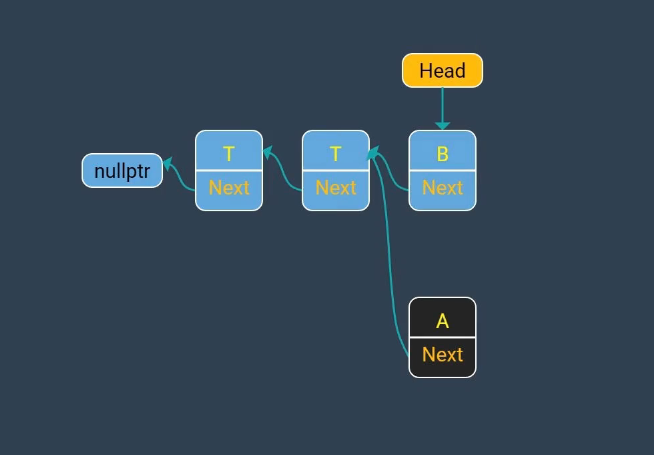
此时另一个线程又向堆栈push了一个新节点B,head指向了B
若第一个线程还将head更新为节点A,则会将节点B孤立
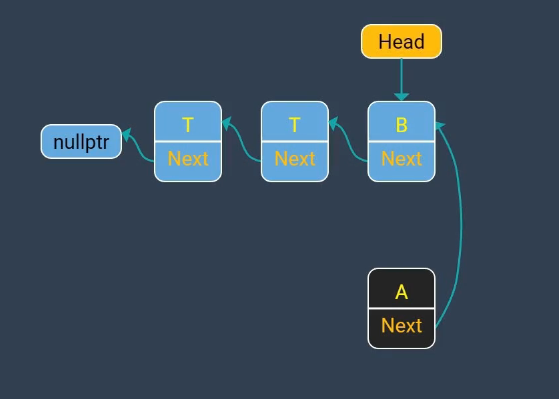
此时我们在compare_exchange函数中将A与B节点的next节点进行比较,若相等,说明头部没有变化,那么可以将A作为新的节点,将head指向A
否则说明已经发生变化,就将A的next值更新为head当前值,并更新head
pop操作更简单,将head当前值存储在局部变量中,再把其next与当前值进行比较,若相等则说明头部未改变,将head更新为头节点next值,否则说明发生变化,将局部变量更新为head当前值,继续循环
1 2 3 4 5 6 7 8 9 10 11 12 13 14 15 16 17 18 19 20 21 22 23 24 25 26 27 28 29 30 31 32 33 34 35 36 37 38 39 40 41 42 43 44 45 46 47 48 49 50 51 52 53 54 55 56 57 58 59 60 61 62 63 64 65 66 67 68 69 70 71 72 73 #include <iostream> #include <atomic> #include <thread> #include <memory> #include <syncstream> template <typename T>class LockFreeStack {private : struct Node { T data; Node* next = nullptr ; Node (T d):data (d){} }; std::atomic<Node*> head; public : LockFreeStack () = default ; LockFreeStack (const LockFreeStack&) = delete ; LockFreeStack& operator =(const LockFreeStack&) = delete ; void push (T val) auto *newNode = new Node (val); newNode->next = head.load (); while (!head.compare_exchange_strong (newNode->next, newNode)); std::osyncstream (std::cout) <<" Pushed: " << val << "\n" ; } bool pop (T &result) Node* oldHead = head.load (); do { if (oldHead==nullptr ){ std::osyncstream (std::cout)<< " Stack is empty, cannot pop.\n" ; return false ; } }while (oldHead&&!head.compare_exchange_strong (oldHead, oldHead->next)); if (oldHead){ result = oldHead->data; std::osyncstream (std::cout)<< " Popped: " << result << "\n" ; return true ; } else return false ; } }; void pushItems (LockFreeStack<int > &stack, int start, int end) for (int i = start; i<end;i++){ stack.push (i); std::this_thread::sleep_for (std::chrono::milliseconds (50 )); } } void popItems (LockFreeStack<int > &stack, int count) int value; for (int i = 0 ; i<count;i++){ stack.pop (value); std::this_thread::sleep_for (std::chrono::milliseconds (30 )); } } int main () LockFreeStack<int > stack; std::thread t1 (pushItems, std::ref(stack), 1 , 10 ) ; std::thread t2 (popItems, std::ref(stack),7 ) ; std::thread t3 (pushItems, std::ref(stack), 10 , 20 ) ; std::thread t4 (popItems, std::ref(stack),7 ) ; t1.join (); t2.join (); t3.join (); t4.join (); return 0 ; }
(这里shared_ptr不是平凡可复制类,故改为了裸指针,同时无法解决ABA问题)
内存模型
顺序一致性模型
程序按照代码编写顺序执行,并且所有线程都看到相同顺序的模型
枚举值名称为memory_order_seq_cst
该模型顺序简单,不易出错,但可能无法充分使用系统和硬件的性能优化
Relaxed模型
relaxed模型下,不对内存顺序作约束,可能出现顺序一致性模型中不会出现的结果
CPU和内存之间会有多级缓存
缓存、编译器的优化都可能改变同一线程不同语句的执行顺序
枚举值名称为memory_order_relaxed
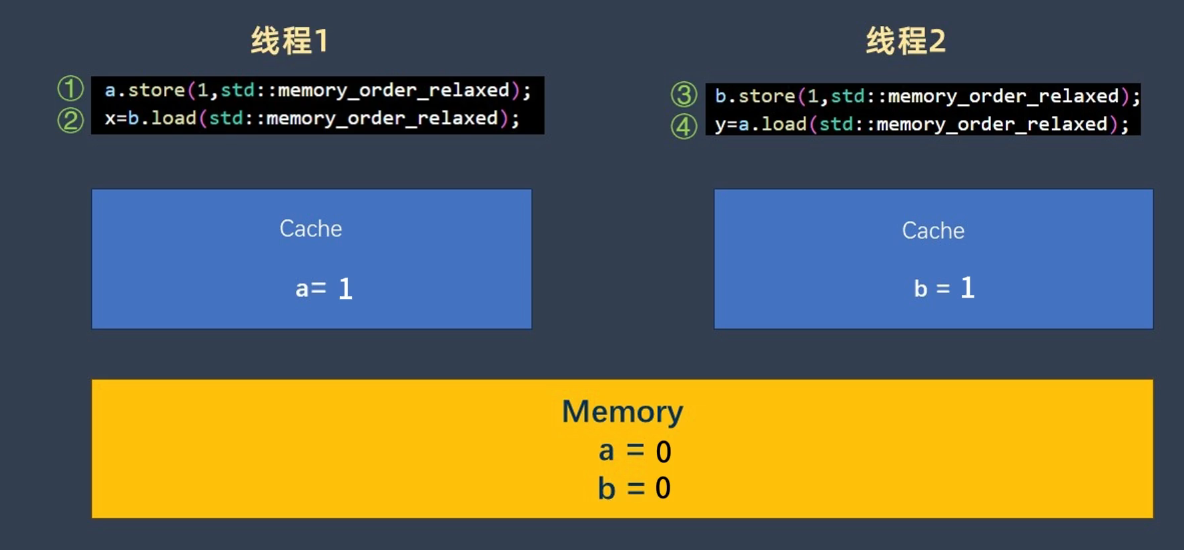
relaxed模型中,线程执行代码对值的更改首先保存在缓存中,当代码执行完毕,才会更新内存中的值
如该例子中,线程1与2执行了①和③代码,将缓存中的a与b修改为1,再执行②和④代码,读取内存中的a与b都为0
在代码执行完毕后,缓存中的值才会修改到内存中
Acquire/Release模型
枚举值有如下三种:
memory_order_acquirememory_order_releasememory_order_acq_rel
通常在原子操作中,
写入数据使用release,即将值写入后,将缓存中的数据发布到内存中,包括之前修改过的其他变量
获取数据使用acquire,即将值从内存中更新到缓存,并读取这个值
对于先加载在修改的,使用acq_rel
在mutex锁中,mutex.lock()与acquire语义是等价的,mutex.unlock()与release语义是等价的,两者之间是临界区
临界区内的代码可以互相调换顺序,但不能移出临界区外
临界区上方的代码可以进入临界区,但不能移出临界区下方
临界区下方的代码可以进入临界区,但不能移出临界区上方
于此对应的memory_order_acquire与memory_order_release遵循同样的原则